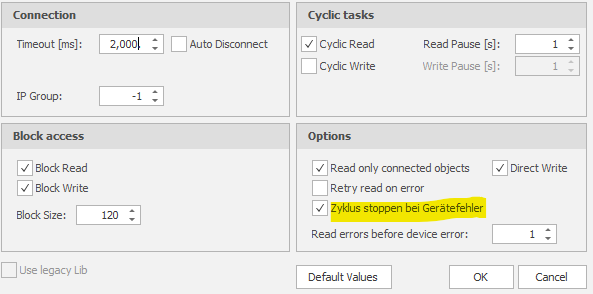
Connection
Timeout [ms] |
2000, 1 … 5000 |
Wait time for a device’s response. If no response is received within this time, the request is considered to have failed (response timeout). |
Auto Disconnect |
Off |
The driver terminates the connection after each communication cycle and reestablishes it for the next cycle. This is useful for devices that cannot maintain open connections permanently or that are only intended to be active for a short time. With Auto Disconnect, an exclusive connection is always used; the **IP group** is ignored. |
IP Group |
−1 … 15 |
Specifies whether the driver establishes its own TCP connection or shares a connection with other Modbus components. - −1: The driver uses its own exclusive connection. - 0 … 15: All components with the same IP address, port, mode, and group share a single connection. This is necessary if a device or gateway accepts only one or a few simultaneous connections. Requests from the involved components are then processed sequentially over this single connection.
For serial connections (RTU/ASCII), this setting has no effect—a COM port is always shared. |
Cyclic Communication
Cyclic Read |
A |
Pause [s] |
1 … 5000 |
The driver reads all readable registers continuously. The pause is the wait time between the end of one read cycle and the start of the next. If cyclic reading is disabled, values are read only on demand via the component’s corresponding data point. |
Cyclic Write |
Off |
Pause [s] |
1 … 5000 |
At this interval, the driver rewrites all writable registers for which a value is known back to the device—regardless of whether the value has changed. Useful for devices that lose values after a reboot or expect a regular default value (watchdog). |
Block Access
Block Read |
A |
Consecutive registers of a device with the same function are read in a single request rather than individually. This significantly reduces the number of requests. A block is formed only from consecutively numbered addresses; a gap in the addresses starts a new block. |
Block Write |
A |
When writing multiple values (cyclic write or batch write; see *Direct Write*), consecutive registers are written in a single request. |
Block Size |
120, 1 … 250 |
Maximum number of registers (or coils) per block. Some devices or gateways only allow smaller blocks—if a device returns errors during block access, reduce the block size. The Modbus protocol itself allows a maximum of 125 registers per request when reading. |
Options
Read only connected objects |
On |
Only registers whose data points are connected to a network are read. This prevents unused registers from generating data traffic. If a driver connection (e.g., MQTT, BACnet server, file logger) is connected to the component, all registers are read because the values are needed there. |
Direct Write |
On |
If a value changes, it is written to the device immediately on an individual basis. If this option is disabled, the value is transmitted during the next cyclic write. If cyclic writing is also disabled, the driver waits briefly (approx. 0.1 s) after a change and then writes all known write values together (as blocks using block writing). This ensures that changes occurring in quick succession are written to the device in a single write operation. |
Retry read on error |
Off |
If reading a block fails, it is repeated once before the error is acknowledged. No retry occurs for devices already considered faulty, nor during the first read operation after establishing a connection. |
Stop Cycle on Device Error |
On |
If a device reports an error (no response, device malfunction, gateway cannot find the device, connection closed), the driver does not read any further blocks from that device during this cycle but continues with the next device. In addition, a malfunctioning device is queried with decreasing frequency (after 10 s, 30 s, 1, 2, 5, 10, and then every 30 minutes) so that a failed device does not slow down the polling of the remaining devices. If it responds again, it is immediately read again in the normal cycle. If this option is disabled, all blocks of the device are attempted in every pass. |
Read errors before device errors |
1 … 10 |
Number of consecutive read cycles in which no register could be read from a device before the device is reported as faulty (device status *false*). The device’s warning is set as early as the first failed pass, the device’s warning flag is set. A higher value prevents fault reports in the event of isolated glitches. During the first read after startup or after establishing a connection, a fault is reported immediately, regardless of this setting. |
Use Old Lib: Uses the older Modbus library instead of the current one. Intended only as a workaround for devices that are not compatible with the current library.
Connection Monitoring (Behavior, no setting)
- If the connection is lost, the driver automatically attempts to reestablish it—initially after 10, 20, 30, and 60 seconds, then every 5 minutes. Each attempt is logged in the component’s diagnostic log along with the time of the next attempt.
- As soon as the connection is reestablished, all devices are queried immediately, even if a wait time was still in progress for a particular device.
- If not a single device responds via a TCP connection during three consecutive read cycles, the connection is discarded and reestablished. If at least one device behind a gateway still responds, the connection remains active; failed devices are then reported only as device errors.
- The connection is additionally monitored using TCP keepalive, so that a disconnected line is detected even during read pauses.